Blog

Two Auxiliaries Killed on Grafton Street 1921

#OnThisDay 1921 Two Auxiliaries, Leonard Appleford (possibly No 6 in pic) & George Warnes were shot dead by the IRA on the corner of Chatham and Grafton Street.

This was part of a bigger plan by the  IRA to encircle the Grafton street area and in one big swoop kill all the uniformed and plain clothed Auxiliaries of F Division that frequented the area. 2nd Battalion, Dublin Brigade IRA were tasked with this mission and would work in groups of twos with an intelligence officer to point out their targets.
Some IRA Volunteers even went to the same restaurants and bars as the Auxiliaries to become more acquainted with their face and their routine. There was even a plan to bomb a restaurant at lunchtime where Auxies would regularly eat but this was squashed. A Ford van was even organised by the IRA to get rid of the corpses.

However, like many military plans worldwide, it did not go to schedule. Most of the IRA volunteers could not get through the British Army checkpoints around the city as they were carrying arms or could have been recognised by the Army. Even the Ford van did not make it through.
Two Volunteers, Kelliher and Rigney, who did make it through the cordon were at the corner of Grafton Street and saw their mark. The operation had been called off but in the spur of the moment, they saw Appleford and Warnes and shot them dead and left the area.

cairogang

Field Marshal Herbert Kitchener Born in Ballylongford, Kerry 1850

#OnThisDay 1850 Field Marshal Herbert Kitchener was born in Ballylongford, Kerry. Kitchener was a soldier & statesman who fought & administered in many parts of the British Empire.

He served in Egypt and was an intelligence officer on the mission to save General Gordon in Khartoum (which failed). He was Governor-General of eastern Sudan during his time he commanded the British Army to the victory at the Battle of Omdurman. Here a tribal Mahdist army twice the size of the British force but lacking the modern military hardware was easily beaten with little to no losses on the British side.

During the Boer War, he was Chief of Staff. Following several defeats and his method of blockhousing the South African countryside to helm in the Boers failed, he introduced a scorched earth policy (a policy included the systematic destruction of crops and slaughtering of livestock, the burning down of homesteads and farms, and the poisoning of wells and salting of fields ) & concentration camps which lead to the deaths of nearly 30,000 people, mostly women and children. A ratio of about one in four inmates.

After the Boer War he served as Chief of Staff in India and then Military Governor in Egypt.

During the First World War, he was appointed Secretary of War. A.J.P. Taylor has pointed out: “He startled his colleagues at the first cabinet meeting which he attended by announcing that the war would last three years, not three months, and that Great Britain would have to put an army of millions into the field. Regarding the Territorial Army with undeserved contempt, he proposed to raise a New Army of seventy divisions and, when Asquith ruled out compulsion as politically impossible, agreed to do so by voluntary recruiting.”

Kitchener had 175,000 men volunteer in the single week ending 5th September. With the help of a war poster that featured Kitchener and the words: “Join Your Country’s Army“, 750,000 had enlisted by the end of September. Thereafter the average ran at 125,000 men a month until June 1915 when numbers joining up began to slow down.

Kitchener died on 5th June 1916 when the ship he was on hit a German mine en route to Russia.

Kitchener

Bernard J.D. Irwin MOH Born in Roscommon 1830

#OnThisDay 1830 Bernard J.D. Irwin, the first (chronologically by action) Medal of Honor recipient was born in Roscommon. As an assistant army surgeon during the Apache Wars, his actions on 13 Feb 1861 are the earliest for which the Medal of Honor was awarded.

Cochise, the Chiricahua Apache chief, and a group of Apache warriors had been accused of kidnapping a boy and a small group of U.S. soldiers in the Arizona Territory after the Army had captured Cochise’s brother and nephews. When the Army refused to make a prisoner exchange, Cochise killed his prisoners. Soldiers then killed Cochise’s brother and nephews. Second Lieutenant George Nicholas Bascom led a group of 60 men from the 7th Infantry after Cochise but was soon besieged, prompting a rescue mission by the army.

In response to the siege of Bascom and his men, Irwin set out on a rescue mission with 14 men of the 1st Dragoons. He was able to catch up with the Apaches at Apache Pass in present-day Arizona. He strategically placed his small unit around Cochise and his men, tricking the Apache leader into thinking that Irwin had a much larger army with him. The Apaches fled and Bascom and his men were saved. Bascom and his men joined Irwin and together they were able to track Cochise into the mountains and rescued the young boy that Cochise had captured previously.

The Medal of Honor wasn’t established until 1862 but it wasn’t until just before he retired as a Brigadier General that Irwin received the award in 1894.

Bernard_J_D_Irwin

The Cushendall Massacre 1922

#OnThisDay 1922 In response to the assassination of Sir Henry Wilson the day previous, ten members of the Ulster Special Constabulary (B-Specials) accompanied by  a group of British soldiers (Green Howards) left Ballymena in 4-5 trucks and drove to the catholic town of Cushendall, Antrim and shot dead three men. They also shot and wounded two others.

Despite the number of credible persons (including the widow of a QUB chemistry professor) who bore witnesses to these tragic events, the Northern Irish Government put out a totally fictitious statement in which they were ambushed by the IRA and killed four in a ‘desperate fight for their lives’. It was mentioned in Westminster by Devlin to Churchill who set up an inquiry but this completely failed. Stormont and the police authorities disagreed with the inquiry’s findings and in the end no Specials were prosecuted for this.

The Protestant government of Northern Ireland dismissed all evidence against the officers, finding no fault in the special police force and awarding no compensation to the families of the deceased’.

This case was buried the investigation under the Official Secret Act and buried it for 50 years. It was then reburied for another 25 years in 1972 given the hostilities then, and it wasn’t until 1997 that the true story came out.

The deceased were 18-year-old James McAllister, 22-year-old John Gore and 26-year-old John Hill.

1920_USC_xlrg

Pat Keane & the Mid-Clare IRA disarm British Soldiers, Ennis 1920

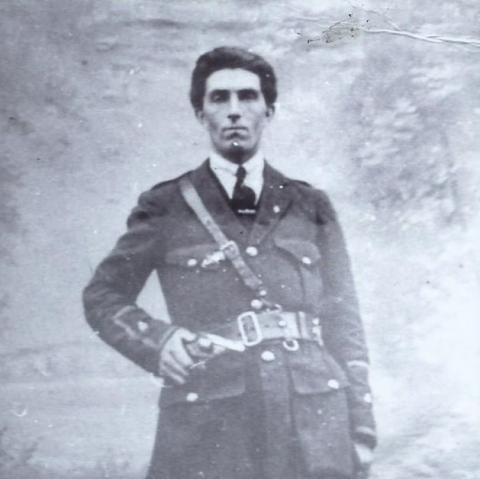
#OnThisDay 1920 Pat Keane & Mid-Clare Brigade Flying Column ambush & disarm a patrol of seven British soldiers who paraded daily at the junction of Carmody St and O’Connell St in Ennis. They made off with several rifles, bayonets and much needed ammunition.

“Pat Keane was attached to the Mid-Clare Brigade of the Volunteers and in turn was Kilnamona Coy (Company) Section Commander (1919), Adjutant (1920) and Officer in Command (1921) with over 60 men under his charge.’

The Ennis assault is interesting in that volunteers were specially selected for a task which required considerable co-ordination – any failure on the part of any of the volunteers could have had disastrous consequences for all.  Intensive rehearsals were held over the previous 12 nights ‘using a party of twenty one men with seven set aside representing the soldiers until each (was) thoroughly proficient in his particular duty’.  A signal whistle blast was given and ‘each member of the guard was attacked individually and simultaneously, so complete surprise, and overpowered at once… it lasted about two minutes’.
The plan of attack was for the splitting up of the men into groups of three, each group of three were to overpower and disarm a designated soldier.  O’Keeffe listed Pat as one such member (of the total 21 listed) assigned to a disarming group.

Success was achieved without loss of life on either side.”

pat keane Clare IRA