Blog

The Larne Gun Running 1914


Larne Gun Running

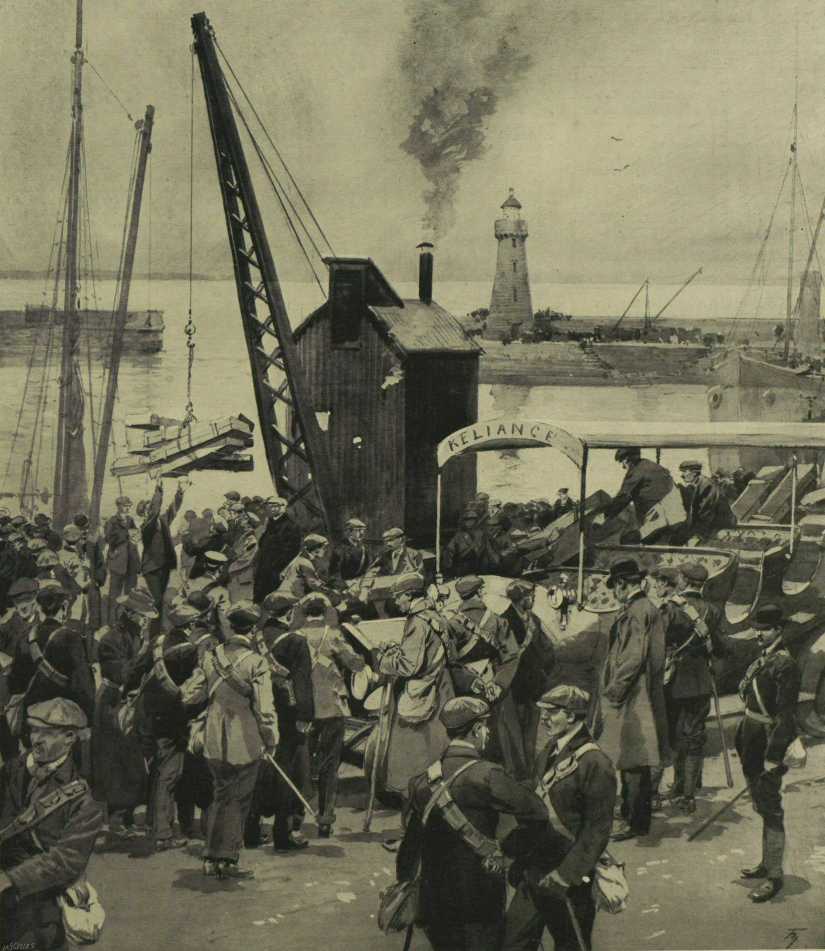
On this night 24/25th of April 1914, the UVF landed thousands of rifles and a million rounds of ammunition into Larne and two other ports in Antrim. They had cleverly fooled the RIC by staging a diversionary ship to port in Belfast and delay its unloading and inspection in ensure the ships with the guns could actually make it to Larne and Donaghadee to unload its precious cargo.
In the ensuing months the Irish Volunteer Force would follow suit and smuggle guns and ammo into Howth.
Ireland was poised for a civil war.

Corporal John Cunningham VC WW1

Irish born Corporal John Cunningham was a recipient of the Victoria Cross for his actions in battle 12 April 1917 at Bois-en-Hache, near Barlin, France.  John was a #Tipperary man and joined the second Battalion of the Prince of Wales’ #Leinster Regiment.

London Gazette for Victoria Cross:

For most conspicuous bravery and devotion to duty when in command of a Lewis Gun section on the most exposed flank of the attack. His section came under heavy enfilade fire and suffered severely. Although wounded he succeeded almost alone in reaching his objective with his gun, which he got into action in spite of much opposition. When counter-attacked by a party of twenty of the enermy he exhausted his ammunition against them, then, standing in full view, he commenced throwing bombs. He was wounded again, and fell, but picked himself up and continued to fight single-handed with the enemy until his bombs were exhausted. He then made his way back to our lines with a fractured arm and other wounds. There is little doubt that the superb courage of this N.C.O. cleared up a most critical situation on the left flank of the attack. Corporal Cunningham died in hospital from the effects of his wounds.

London Gazette 8th June 1917

John is buried in Barlin cemetery, Pas de Calais, plot 1, row A, grave 39.
John Cunningham

The Battle of Clontarf 1014

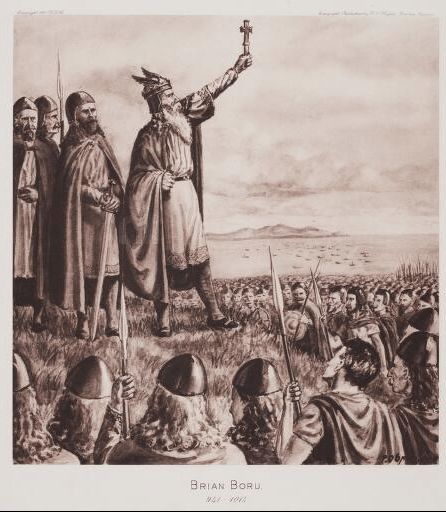
NLI Brian Boru

On this day over a thousand years ago in 1014, Brian Boru, the High King of Ireland fought the Battle of Clontarf against an army of Leinster-men and their Viking/Norse allies. While the battle was a victory for Boru, he was killed while praying in his tent.
Contrary to most beliefs, he was neither the last High King of Ireland nor did he defeat the Viking raids around Ireland, they’d stopped large scale raiding decades ago.

Captain George McElroy

George McElroy.jpg

Captain George McElroy MC & two Bars, DFC & Bar. An Irish born fighter pilot ace with 47 enemy kills. McElroy flew with the British RFC and RAF during the First World War.

Distinguished Flying Cross (DFC)
Lt. (T./Capt.) George Edward Henry McElroy, M.C.
A brilliant fighting pilot who has destroyed thirty-five machines and three kite balloons to date. He has led many offensive patrols with marked success, never hesitating to engage the enemy regardless of their being, on many occasions, in superior numbers. Under his dashing and skilful leadership his flight has largely contributed to the excellent record obtained by the squadron.

Military Cross (MC)
2nd Lt. George Edward Henry McElroy, R.G.A. and R.F.C.
For conspicuous gallantry and devotion to duty. He has shown a splendid offensive spirit in dealing with enemy aircraft. He has destroyed at least two enemy machines, and has always set a magnificent example of courage and initiative.

Military Cross (MC) First Bar
2nd Lt. George Edward Henry McElroy, M.C., R.G.A., and R.F.C.
For conspicuous gallantry and devotion to duty. When on an offensive patrol, observing a hostile scout diving on one of our aeroplanes, he opened fire, and sent down the enemy machine in an irregular spin out of control, when it finally crashed completely. Later in the same day, he sent down another enemy machine in flames. On another occasion, when on offensive patrol, he singled one out of four enemy machines, and sent it down crashing to earth. On the same day he attacked another enemy machine, and, after firing 200 rounds, it burst into flames. On a later occasion, he opened fire on an enemy scout at 400 yards range, and finally sent it down in a slow spin out of control. In addition, this officer has brought down two other enemy machines completely out of control, his skill and determination being most praiseworthy.
(M.C. gazetted 26th March, 1918.)

Military Cross (MC) Second Bar
Lt. (T./Capt.) George Edward Henry McElroy, M.C., R.G.A., and R.F.C.
For conspicuous gallantry and devotion to duty. While flying at a height of 2,000 feet, he observed a patrol of five enemy aircraft patrolling behind the lines. After climbing into the clouds, he dived to the attack, shot down and crashed one of them. Later, observing a two-seater, he engaged and shot it down out of control. On another occasion he shot down an enemy scout which was attacking our positions with machine-gun fire. He has carried out most enterprising work in attacking enemy troops and transport and in the course of a month has shot down six enemy aircraft, which were seen to crash, and five others out of control.
(M.C. gazetted 26th March, 1918.)
(1st Bar gazetted 22nd April, 1918.)

Distinguished Flying Cross (DFC) Bar
Lieut. (T./Capt.) George Edward Henry McElroy, M.C., D.F.C. (Royal G. Artillery).
In the recent battles on various army fronts this officer has carried out numerous patrols, and flying at low altitudes, has inflicted heavy casualties on massed enemy troops, transport, artillery teams, etc., both with machine-gun fire and bombs. He has destroyed three enemy kite balloons and forty-three machines, accounting for eight of the latter in eight consecutive days. His brilliant achievements, keenness and dash have at all times set a fine example and inspired all who came in contact with him.
(M.C. gazetted 26th March, 1918, 1st Bar 22nd April, 1918, 2nd Bar 26th July, 1918. D.F.C. gazetted 3rd August, 1918.)

He would be shot down a week after Mannock on 31 July 1918. The RAF lost two of its best pilots so suddenly.